
Petrified Wood Coffee Table Manufacturer & Exporter In Indonesia
Industrial Cross Section Production from Indonesia
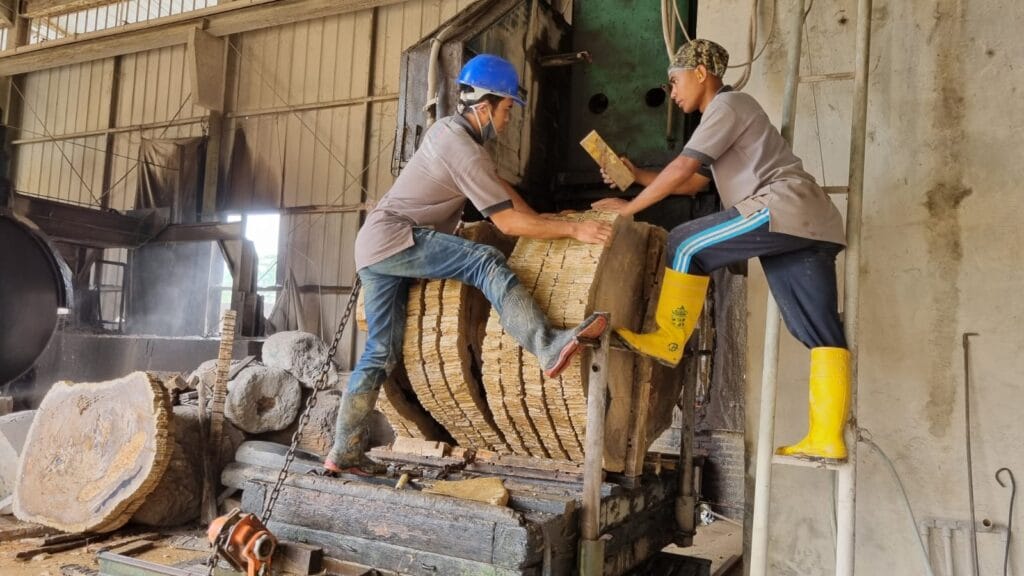
Petrified wood coffee tables manufactured in our Bogor facility are cut directly from allocated fossil trunks under structured industrial planning.
Production is not based on speculative showroom inventory. It is organized around raw log selection, dimensional classification, structural stabilization, and export preparation designed for container-scale distribution.
Unlike dining tables, which focus on long-span slab engineering, coffee tables represent our scalable production engine. Multiple size classes allow continuous throughput without compromising fossil integrity.
Annual production history demonstrates consistent output across several formats, including:
- Round cross-section slabs
- Rectangular slab tables
- Engineered joint tables
- Mosaic recovery tables
- Solid and hollow stump formats
Petrified Wood Round Coffee Tables
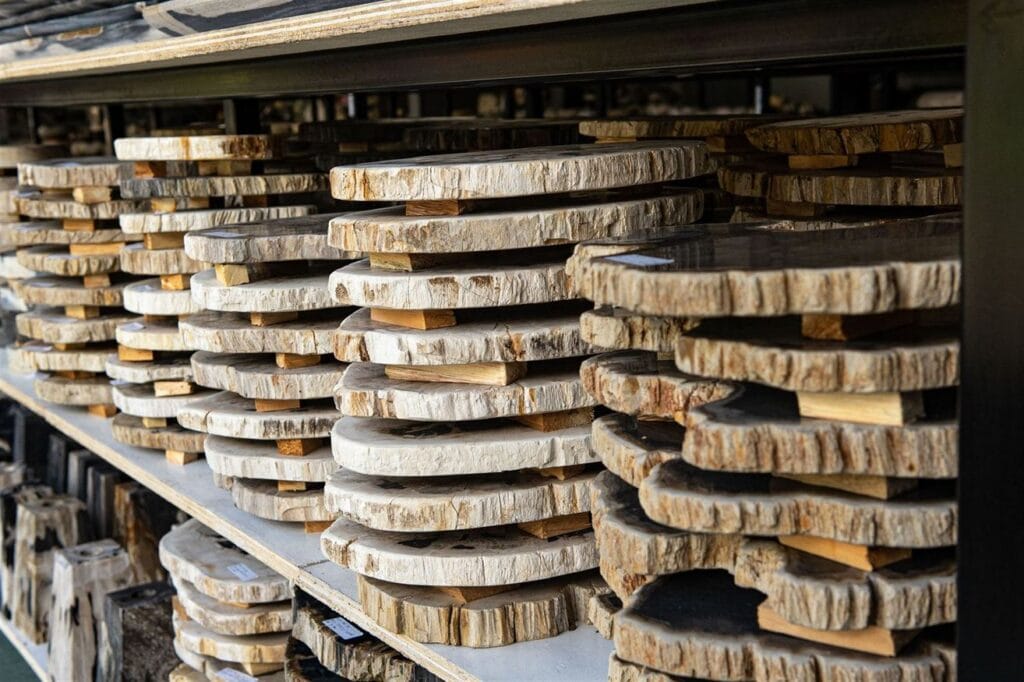
Coffee table production is integrated within our 7 cutting machine system and 20 polishing stations. Round formats are cut from full fossil trunk cross-sections whenever structurally viable. Slabs move from primary cutting to grading, stabilization, finishing, and export preparation without entering warehouse inventory cycles.
Production is structured around raw fossil log allocation.
Orders are fulfilled either through current graded slabs or through fresh cutting from selected fossil trunks based on dimensional and mineral requirements.
This dual-structure model ensures buyers are not limited to pre-cut inventory but can access controlled raw material selection aligned with their program needs.
Our facility operates as an integrated fossil processing system. From raw trunk allocation to cutting, stabilization, polishing, grading, and container sealing, each stage is coordinated within a single production workflow.
Inventory exists as graded allocation, not as speculative trading stock.
Size Classification & Structural Range Architecture
Industrial fossil production only makes sense when size classes are structured.
Your coffee table program is not random. It follows dimensional logic.
Round Cross-Section Coffee Tables
Most round tables are cut from full fossil trunk cross-sections. The visible tree rings are not printed patterns. They are preserved mineralized cellular structures formed over millions of years.
Custom Diameter Cutting Program
For distributors and project buyers requiring non-standard diameters, we allocate raw fossil trunks and cut to specification.
Custom cutting allows:
- Diameter targeting beyond current stock
- Thickness control based on structural use
- Tone coordination from selected trunk
- Edge shaping prior to finishing
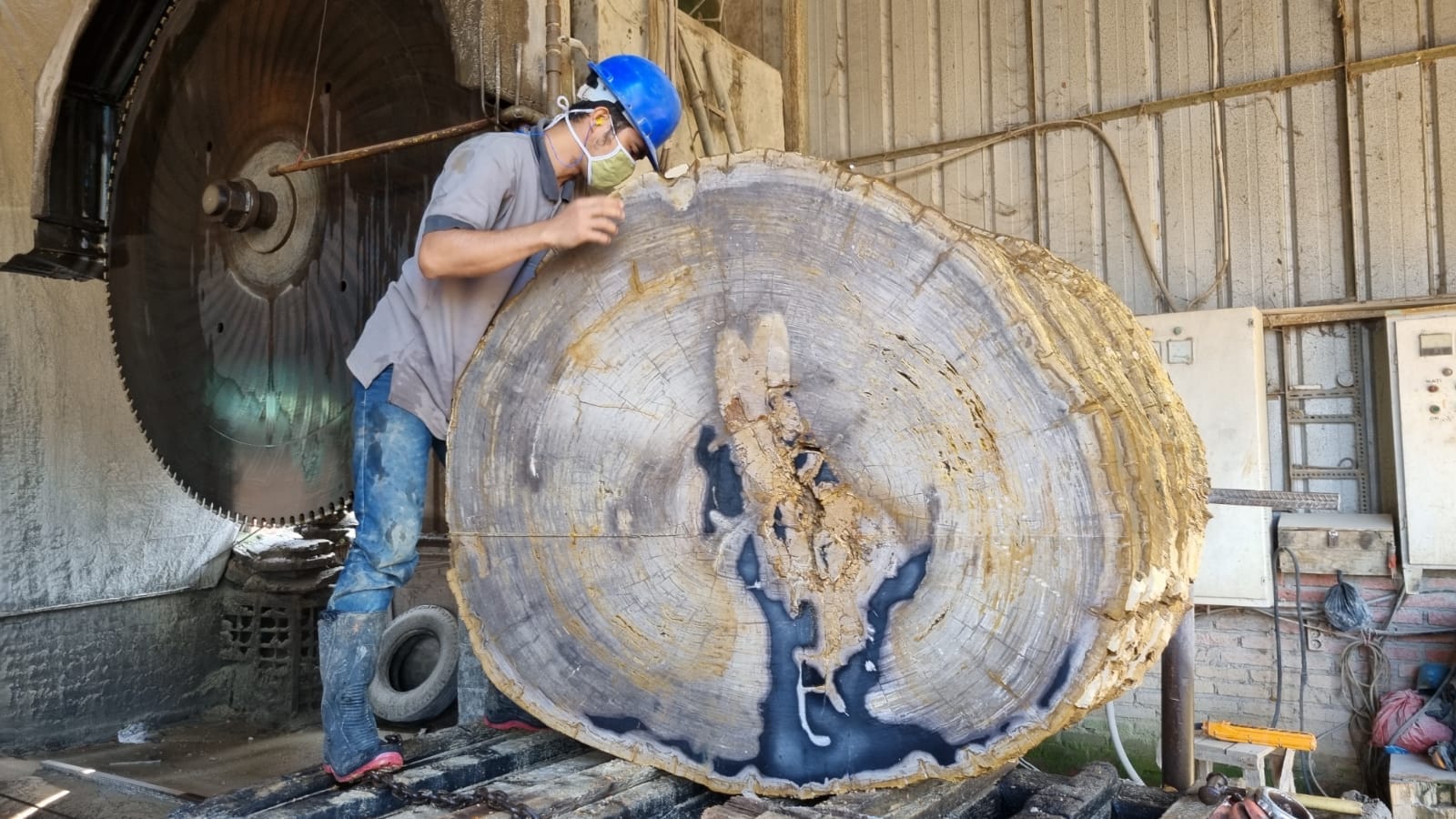
We classify round tables into five operational size tiers.
| Size | Diameter | Thickness | Weight | Suitable for |
| S | 60–80 cm | 3–7 cm | 30–50 kg | • Side tables • Paired lounge arrangements • Compact hospitality seating |
| M | 80–100 cm | 4–9 cm | 50–90 kg | This is the most consistent distributor category. Balanced diameter and weight allow efficient mixed container loading. |
| L | 100–120 cm | 5–10 cm | 90–115 kg | This range begins entering architectural statement territory while remaining logistically manageable. |
| XL | 120–140 cm | 6–10 cm | 115–220 kg | • Premium showroom installations • Hospitality lobby focal points • High-end residential projects |
| XXL | 140–190+ cm | 6–10 cm | 150–270 kg. Rare heavy slabs may exceed 500 kg | XXL slabs are allocation-based. Availability depends on raw fossil log diameter and structural stability. |
When dimensional requirements exceed available graded slabs, raw fossil trunks are allocated for fresh cutting. Diameter targeting, thickness calibration, and tone selection are defined before primary cutting begins.
This ensures structural integrity and dimensional consistency rather than adapting finished slabs to specification after the fact.
Rectangular Slab Coffee Tables
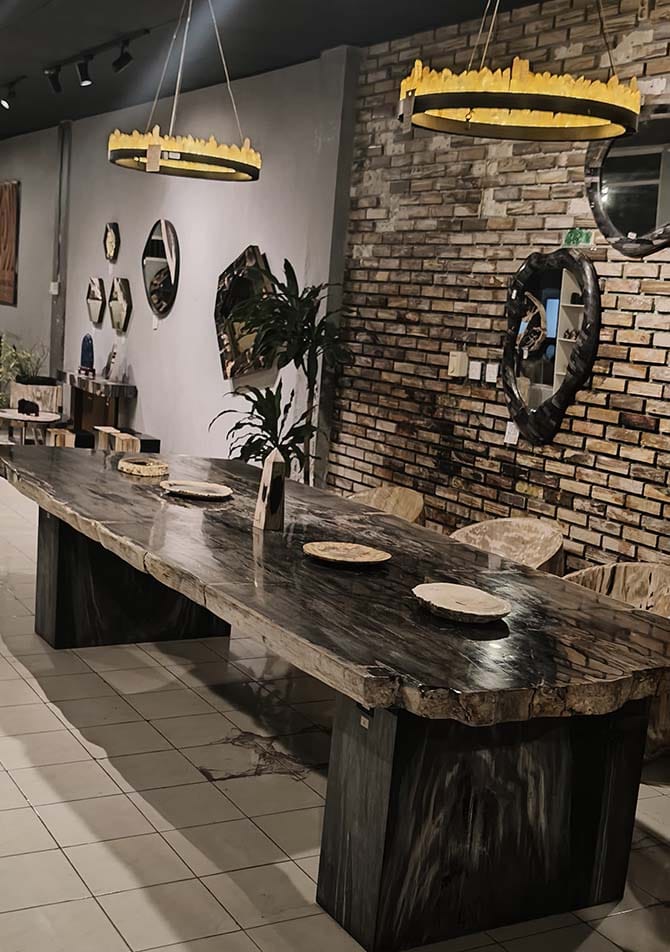
While round formats represent fossil trunk cross-sections, rectangular slab coffee tables are cut longitudinally from large fossil logs.
Advantages:
- Higher margin per batch
- Cleaner linear design profile
- Easier pairing with modern architecture
- Stable support distribution
Rectangular slabs often range:
Length: 100–160 cm typical
Width: 60–100 cm
Thickness: 4–8 cm
Rectangular formats are frequently preferred in repeat distributor programs due to stacking efficiency and dimensional predictability.
For large-format structural slabs and hospitality-scale installations, see our Petrified Wood Dining Tables category.
Solid vs Hollow Construction
Most buyers prefer solid construction.
| Solid: | Hollow (upon request): |
| • Higher perceived value • Maximum structural density • Premium weight presence | Reduced shipping weight Easier container optimization Suitable for high-volume distributor programs |
Hollow versions are carefully engineered to maintain exterior integrity while reducing total load mass.
This structured size architecture allows distributors and project buyers to build predictable SKU programs instead of one-off decorative purchases.
Container Optimization & Distributor Supply Model
Coffee tables are structurally different from dining tables in one critical way:
They are container efficient.
Because diameter ranges are modular and thickness is controlled, coffee tables allow optimized weight distribution inside 20ft and 40ft containers.
Mixed Container Strategy
Most distributors do not load containers with one single SKU.
Instead, a typical 20ft container program may include:
• Round S and M coffee tables
• Selected L or XL statement pieces
• Complementary stools or side tables
• Mosaic or slice-based tables
• Decorative fossil units for margin balancing
This mixed-SKU structure allows:
• Weight-balanced container planning
• Retail assortment diversity
• Margin blending between high-volume and premium units
• Reduced freight risk
Coffee tables play a central role in this strategy because:
• They are dimensionally predictable
• They stack more efficiently than large dining slabs
• They provide repeatable reorder programs
Weight & Load Planning
Typical 20ft container:
8–11 tons
Typical 40ft container:
15–18 tons
Because round coffee tables in the M and L category typically weigh between 60–120 kg, distributors can calculate SKU distribution precisely.
Example logic:
| Because round coffee tables in the M and L category typically weigh between 60–120 kg, distributors can calculate SKU distribution precisely. Example logic: | • Weight distribution • Internal crate spacing • Structural bracing • Container floor load balance |
| • 40–60 mid-size round tables • Or mixed with stools and sinks • Or balanced with 4–6 larger statement slabs | Reduced shipping weight Easier container optimization Suitable for high-volume distributor programs |
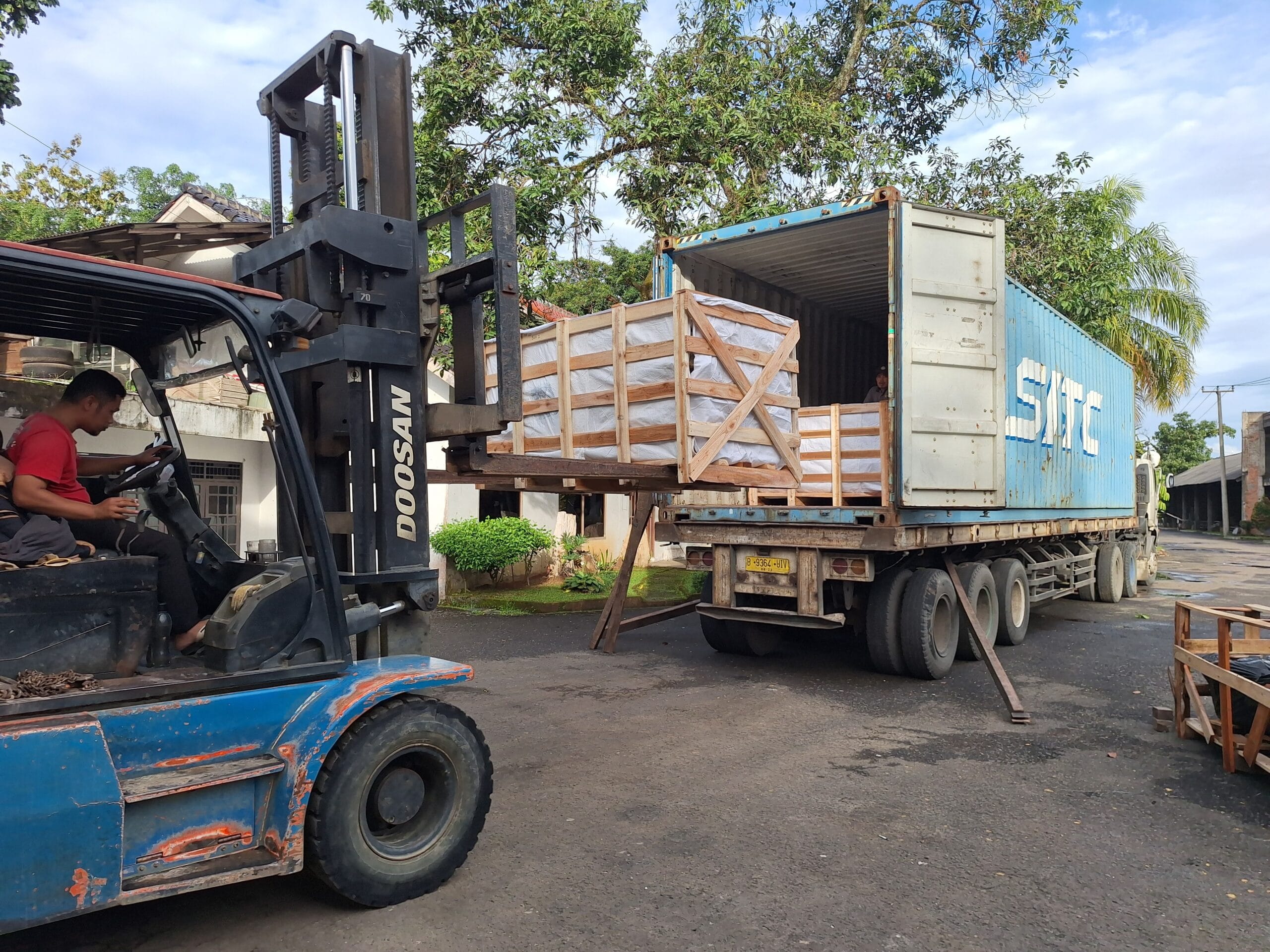
All loading is photo and video documented before sealing.
Production to Export Flow
Most units do not sit in storage inventory.
Production is largely order driven.
It also ensures distributors receive recently processed slabs rather than aged warehouse stock.
Coffee tables move through:
Cutting
Stabilization
Polishing
Quality grading
Crating
Container loading
Most units do not sit in storage inventory.
Production is largely order-driven.
This reduces:
• Handling damage risk
• Surface contamination
• Storage space inefficiency
Raw Log to Container Flow
Raw Log Selection → Primary Cutting → Stabilization → Grading → Crating → Container Sealing
Distributor Repeat Model
Because fossil variation is natural, distributors often establish:
• Size based reorder programs
• Finish level standards
• Color tone preference guidelines
For mid-range sizes (80–110 cm), production consistency allows recurring container programs.
Rectangular longitudinal slabs allow more controlled dimensional planning and support standardized architectural programs.
Material Recovery, Mosaic Engineering & Fossil Utilization Discipline
Mosaic units are engineered from structurally viable offcuts, not decorative scrap.
Petrified wood is not a manufactured material.
It is a finite fossil resource formed over millions of years.
Because of that, responsible production requires controlled material utilization.
Primary Cutting Reality
During initial slab cutting from large fossil logs, structural fractures may appear:
• Internal crack lines
• Density shifts
• Stress points under blade vibration
When a slab cannot meet structural standards for large-format use, it does not automatically become waste.
Instead, it enters a secondary recovery process.
Recovery engineering increases total fossil utilization efficiency across our production ecosystem
Mosaic Coffee Tables
Mosaic tables are engineered from recovered fossil segments. This is not random assembly.
It is controlled reconstruction using:
- Matched fossil tones
- Balanced density pieces
- Stabilized bonding methods
- Precision finishing
This allows:
- Reduction of fossil waste
- Utilization of rare mineral tones
- Creation of artistic pattern compositions
- Controlled margin recovery from offcuts
Mosaic formats include:
- Round mosaic tables
- Rectangular mosaic tables
- Slab mosaic panels
For distributors, mosaic tables provide:
- Accessible entry price category
- Visual diversity
- Sustainable material positioning
Slice Based Coffee Tables
Slice tables, particularly in the 30–50 cm category, are cut from controlled fossil cross-sections.
These are often used for:
- Nesting sets
- Cluster arrangements
- Boutique retail formats
Because slice diameter is smaller, they provide:
- Higher piece count per container
- Flexible SKU layering
- Margin distribution balance
Large slice production in 2022 exceeded several thousand units across categories.
This confirms industrial-scale fossil utilization.
Waste Discipline & Structural Respect
Material that cannot meet structural or aesthetic grading is not shipped.
Recovery strategy ensures:
- Minimal fossil loss
- Controlled grading standards
- Long-term supply sustainability
This operational philosophy strengthens:
- Supply longevity
- Material efficiency
- Manufacturing credibility
Unlike decorative traders who treat fossil wood as casual commodity, we approach it as geological inventory requiring disciplined extraction and allocation.
Strategic Procurement & Ordering Workflow
Our production model is engineered for predictable supply chains. While we maintain a curated selection of ready-to-ship slabs, our core focus is the fulfillment of industrial-scale export programs.
Program Definition
Distributors are encouraged to define their SKU Mix based on regional market demand. A standard 20ft container optimization typically follows a balanced ratio:
- 60% Volume Core: Medium (M) Round & Rectangular slabs (High velocity retail).
- 30% Designer Tier: Large (L) and Extra Large (XL) focal pieces.
- 10% Statement/Margin Balance: XXL allocation-based slabs and Mosaic recovery units.
Specification & Selection
Once the volume is defined, our export team coordinates:
- Tone Profiling: Selection of fossil color palettes (e.g., carbonized blacks, creamy silicates, or ferruginous reds).
- Edge & Finish Standards: Mirror-polish, matte, or natural-edge bark preservation.
- Base Integration: Predrilled mounting points for custom steel base compatibility.
Production & Quality Grading
Unlike warehouse resellers, our Bogor facility provides real-time transparency.
- Lead Times: Standard 20ft container programs typically require 4–8 weeks depending on size distribution and finishing complexity.
- Quality Check (QC): Every slab undergoes structural stabilization and moisture-content verification before crating.
Who This Page Is Built For
This page is not designed for retail buyers.
| It is structured for: | If you are seeking: |
| • International stone distributors • Furniture importers • Hospitality developers • Interior project contractors • Private label fossil programs | • Container-scale fossil production • Cross-section trunk authenticity • Structured size classification • Sustainable recovery engineering • Direct manufacturer coordination |